


BLOG
The Power of Context in Legal Work: Three Things Every Legal Professional Should Know


Colleen Baehrend
Legal Solutions Director
As a lawyer, I’ve long understood that context is everything. We don’t just rely on the law, we rely on how it’s been applied, argued, and tested across matters, clients, and relationships over time to understand what it means and what action to take next.
That’s why the webinar NetDocuments recently held on The Power of Context in Legal Work resonated with me. The discussion reinforced something I’ve observed throughout my career: access to information alone isn’t enough. The real value comes from understanding information in context.
If you missed the webinar, I encourage you to watch the recording. In the meantime, here are three key takeaways from the conversation that stood out to me, and why I believe they’ll have a lasting impact on how legal professionals work.
1. Legal work has always been about context
Early in the webinar, Nate Ruiz said: “you wouldn’t expect an associate to operate at a high level without context. So why do we expect AI tools to do the same?”
What struck me wasn’t just the point about AI. It was the reminder that legal work has always depended on context. Lawyers don’t create value simply by simply knowing the law. We create value by applying it. Applying it well requires understanding how information connects: to a client, a matter, a prior strategy, a business objective, or a risk profile. The same challenge exists across law firms and legal teams every day. Valuable knowledge lives in prior matters, work product, emails, and the experience of the professionals who created them. Yet that context is often difficult to surface when it’s needed most.
Nate referenced something I recognize from years of practice: the “pardon the interruption” email. The one where someone asks who’s handled a situation like this before, or who the subject matter expert is on a given practice area. Those questions aren’t evidence of a lack of knowledge. They’re evidence that the context surrounding that knowledge remains fragmented. It’s buried in unstructured documents and locked in the memory of whoever happened to work on the matter.
So how can law firms and legal teams ensure that knowledge translates into better judgment, faster? The legal context graph is NetDocuments’ answer: the industry’s first system to continuously connect every matter, document, communication, and piece of institutional expertise across an organization, within existing permissions and ethical walls.
2. Connected context changes what’s possible from the moment you open a matter
One of the persistent frustrations of legal practice is the time spent reconstructing context that already exists. Every lawyer knows the experience: you’re staffed on a new matter and the first hours go to figuring out what’s already been done, who has relevant experience, and what positions the organization has taken before. That work isn’t strategic. It’s retrieval.
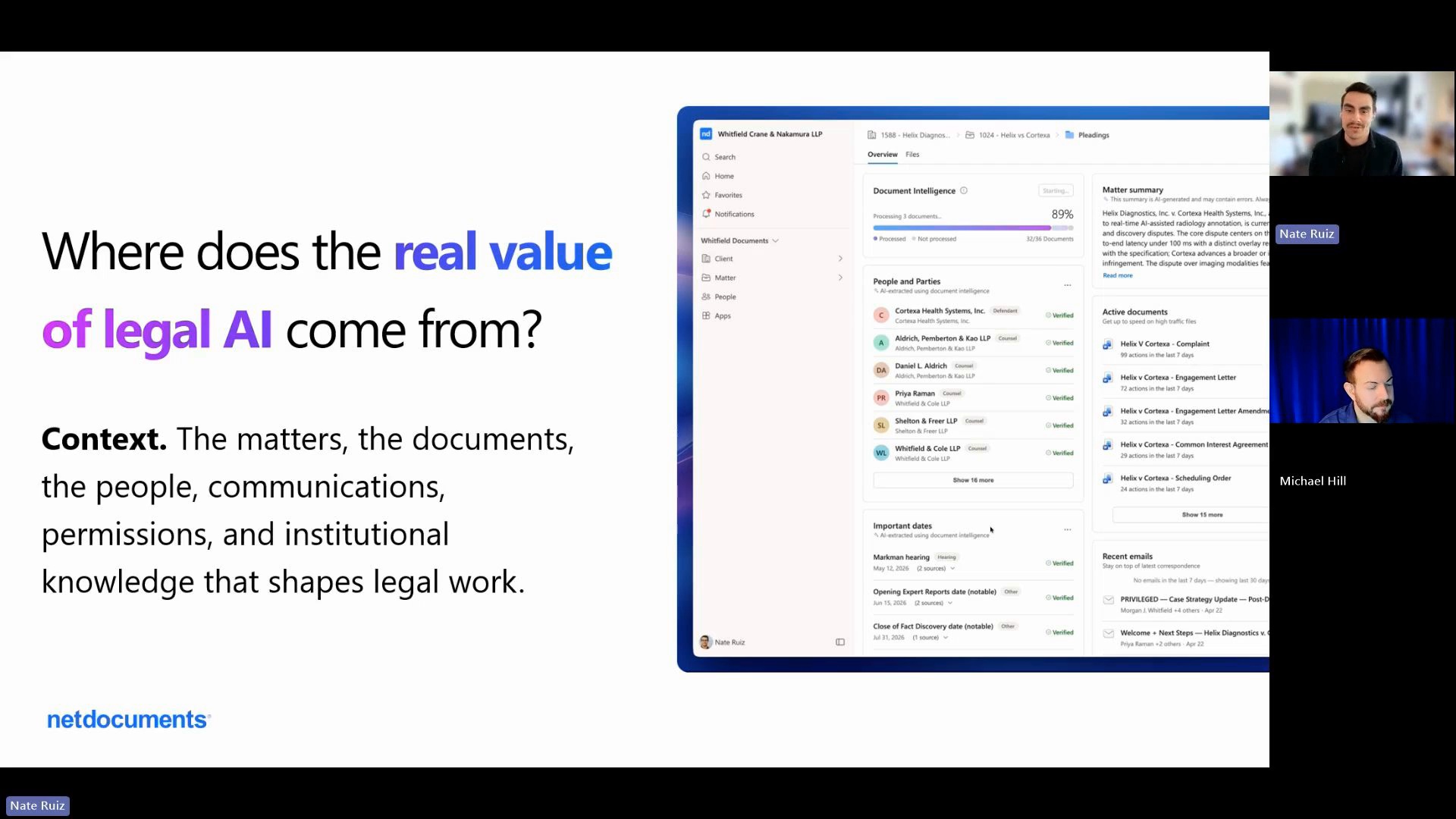
The webinar illustrated what it looks like when that retrieval is handled automatically. For litigators, opening a matter surfaces a full picture: parties involved, key dates, the most active documents, recent team activity, and version-by-version summaries of how key documents have evolved. Finding prior strategy on similar claims works by meaning rather than keyword matching, so relevant arguments and precedent surface even when the exact wording differs.
For transactional lawyers, a document intelligence tab surfaces related documents across matters automatically. Relevant precedent, comparable clauses, or prior negotiating positions are brought forward without anyone needing to remember where they were filed or which matter they belonged to.
The shift is straightforward to describe but significant in practice: instead of spending the first part of every matter catching up, lawyers start with clarity. That changes the quality of the work, the speed of delivery, and the confidence behind every decision.
Sometimes it’s easier to see than to describe. Watch the demo here to see context surfacing in the actual workflow.
30-SECOND QUICK TAKE:
Where does the real value of AI come from?
3. MCP can help the AI tools you’re already using perform better with richer context
A question I hear frequently from legal professionals is: we already have AI tools in place, so why aren’t the results better? The answer, in most cases, is context. The tools are performing exactly as well as the context they can reach. If the underlying system can’t connect prior matters, prior positions, and institutional expertise, the AI is doing its best work with incomplete information. And incomplete information produces incomplete advice.
The webinar addressed this directly in the Q&A, and the framing was useful: MCP (Model Context Protocol) is infrastructure. Think of it as a USB connection. It allows tools to communicate with your document platform, but it doesn’t create context that doesn’t exist. Vendors positioning MCP support as the solution to the context problem are describing the pipe, not what’s flowing through it.
When the underlying system has rich, connected, semantically understood legal context, every AI tool that connects through it gets better. Harvey, Legora, Claude, ChatGPT Enterprise, and others all benefit from the quality of context they can reach. The context graph is what makes those tools genuinely useful for legal work, rather than useful for generic tasks. For legal professionals, accuracy determines trust. Tools that generate plausible-but-wrong outputs don’t get adopted. When governance is built into the same foundation, with permissions, ethical walls, and audit trails, legal teams can extend AI to the work that actually matters, without compromising the standards the profession requires.
Watch the recording to see how context changes everything
What I took away from this webinar is something that’s been missing from legal technology for a long time: not a better search tool, not a smarter document editor, but a platform that finally makes visible the connections that have always lived in a lawyer’s mind. That’s a different kind of progress, and it has practical implications for how firms and legal teams operate.
The recording includes a live demo, real use cases across practice areas and legal team types, and a Q&A that gets into the practical questions: commercial availability, how this fits with existing NetDocuments installations, and what the migration path looks like. If you’re thinking about your organization’s AI strategy or just trying to understand what’s actually different about this moment in legal technology, it’s worth your time.
Share
Level up with these blogs
-

- Blog
Inspire 2026 recap: Get your context right, and the rest gets easier
At Inspire 2026 in Orlando, Florida, customers, partners and the legal…
-

- Blog
Beyond the AI Use Case List: Start With the Problem
Everything you need to work on a matter, right at your…
-

- Blog
Stop comparing legal documents by hand: Six new ndMAX Studio apps
Everything you need to work on a matter, right at your…
-

- Blog
NetDocuments connects organizational legal knowledge to Microsoft Copilot through MCP
Everything you need to work on a matter, right at your…