



BLOG
Inspire EMEA 2026: Scaling the value of legal AI

Colleen Baehrend
Director, Legal AI Solutions
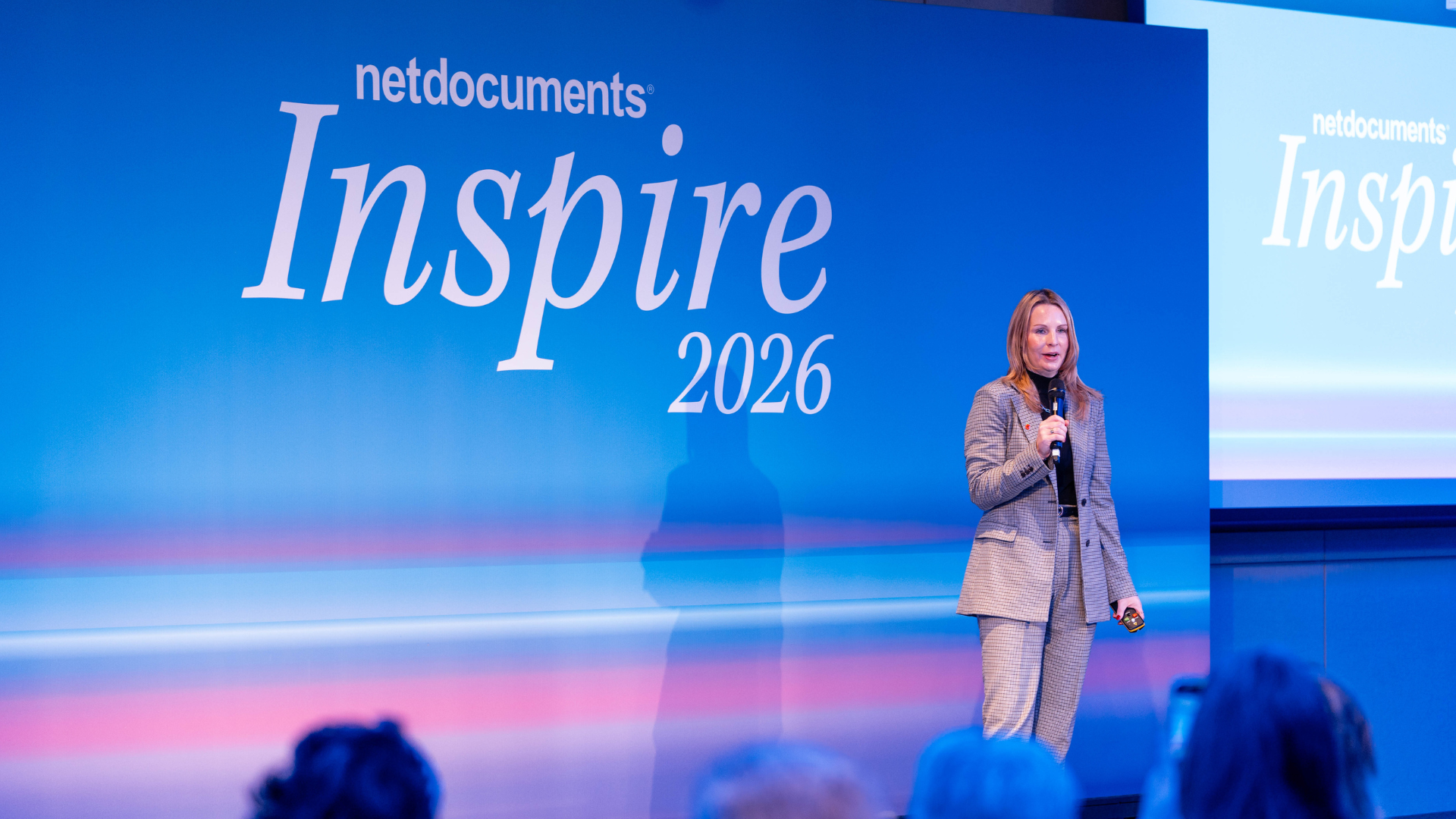
The conversation about Legal AI continues to evolve rapidly. At Inspire EMEA 2026, NetDocuments CEO Josh Baxter opened the event by reflecting on how quickly the industry has moved from exploring what generative AI can do to asking a more practical question: how can organisations make AI useful, reliable and economically sustainable at scale?
That question ran through the day’s discussions, from the Legal Context Engineering Benchmark Report to sessions on knowledge management, interoperability, adoption and the changing relationship between law firms and their clients. A common theme emerged: the value of AI depends not just on the technology itself, but on the context in which it operates.
From experimentation to sustainable impact
As firms move from pilots and individual use cases towards broader adoption, questions of efficiency and cost become harder to ignore.
The information available to an AI system can have a significant bearing on the quality, efficiency and cost of the result. Where context is incomplete, the system may require more detailed input from the lawyer and consume more tokens, while still producing an answer that needs further refinement. This can limit the practical value of AI, even where the underlying technology is capable of performing the task.
The challenge is to give AI the context it needs to produce not just more useful results but more efficient ones. That was the starting point for the Inspire keynote, Context Changes Everything, and for the Legal Context Engineering Benchmark Report, which explored how the context provided to AI impacts its effectiveness and token cost.
What the benchmark report tells us about context
AI effectiveness depends on several factors, including the model, the AI tool (or harness) through which it is used and the information made available to it. The benchmark examined the impact of context by holding the model and harness constant while changing the context supplied.
The reported findings were significant: providing richer context on the frontier model achieved the same level of accuracy at nearly half the cost per accurate answer. The benchmark also found that, by reinvesting some of those savings, organisations could achieve higher accuracy while still lowering cost.
These findings suggest that the context surrounding a task is not simply an input to the model; it can influence how efficiently the task is completed.
The results should be considered alongside the benchmark’s methodology and the scenarios it tested. Firms will need to assess how the findings translate to their own data, tools and workflows. But the broader question is an important one: what changes when AI begins with the relevant context, rather than having to work from a more limited view of the task?
Making institutional knowledge meaningful
Context is not simply about giving AI access to more information. It is about making information meaningful.
A document may contain the terms of an agreement, but its relevance can depend on the client, the matter, the jurisdiction, the people involved and the decisions that preceded it. A precedent may be useful not only because of its wording, but because of the experience and judgement that shaped it. Institutional knowledge, meanwhile, can be difficult to preserve when it is scattered across documents, systems and individuals.
Several Inspire EMEA sessions explored these challenges, from tackling taxonomy and future-proofing firm knowledge to reconsidering institutional memory in the age of AI. The underlying issue is familiar to knowledge professionals: information that cannot be found, understood or applied has limited practical value. AI may improve how lawyers search for and interact with information, but it does not remove the need to organise knowledge or understand the circumstances in which it was created.
Nor does making knowledge more accessible mean making it universally available. In legal work, context must remain subject to confidentiality, permissions, ethical walls and other obligations. The objective is to make the right information available to the right people for the right purpose.
Connecting systems and people
The discussion of context also extended beyond the boundaries of a single organisation or technology platform.
In Closing the Client–Counsel Divide, panellists considered how AI is reshaping collaboration between in-house legal teams and external counsel. The opportunity is not simply to exchange documents more efficiently, but to build a better shared understanding of the work: the client’s priorities and risk appetite, the firm’s legal expertise, and the knowledge accumulated through the relationship.
Interoperability is part of that opportunity. Different systems and AI tools may need to exchange information or continue work across environments. But technical connectivity alone does not ensure useful or trustworthy collaboration. Relevant context must move with the task, while access controls and accountability remain intact.
Technology only creates value when it becomes part of the work
The programme at Inspire EMEA also explored the human and organisational dimensions of legal AI, including change management, adoption, legal engineering and the practical application of technology to document-intensive work.
Successful adoption is not simply a matter of making a tool available. Firms need to identify where AI is useful, integrate it into workflows, build confidence in its use and evaluate its impact. That also means making choices: not every task needs AI, and not every promising use case should be scaled immediately. The best starting points are those where there is a clear legal or business need and where the information required can be made available appropriately.
The goal is not to use AI everywhere. It is to use it where it can make a meaningful difference.
Celebrating the EMEA customer award winners
EMEA Inspire was also an opportunity to recognise customers whose work and partnership deserve particular recognition. Congratulations to this year’s EMEA Customer Award winners:
- CIE Legal
- Dobson Mitchell Allport
- Avant Insurance Limited
- Anderson Lloyd
- McInnes Wilson Lawyers
The next phase of legal AI
Inspire EMEA 2026 reflected an industry moving beyond the initial excitement of generative AI and towards the more complex work of making it useful in practice.
The benchmark highlighted the relationship between context, effectiveness and cost. The wider programme explored what it takes to translate that potential into practice: meaningful knowledge, connected workflows, responsible governance and effective adoption.
The next phase of legal AI will depend not only on what models can do, but on the knowledge and judgement that firms bring to the work. At Inspire EMEA, that was the central conversation and one that will continue well beyond the event.
Explore the findings in the Legal Context Engineering Benchmark Report and consider what they might mean for your firm’s approach to AI.
Share
See what else is new in these blogs:
-

- Blog
Inspire 2026 recap: Get your context right, and the rest gets easier
At Inspire 2026 in Orlando, Florida, customers, partners and the legal…
-

- Blog
Beyond the AI Use Case List: Start With the Problem
Everything you need to work on a matter, right at your…
-

- Blog
Stop comparing legal documents by hand: Six new ndMAX Studio apps
Everything you need to work on a matter, right at your…
-

- Blog
NetDocuments connects organizational legal knowledge to Microsoft Copilot through MCP
Everything you need to work on a matter, right at your…